Regulation
The Consumer Duty board report: what the FCA says good looks like
By Tom Matthieson · 20 July 2026 · Updated 17 September 2026
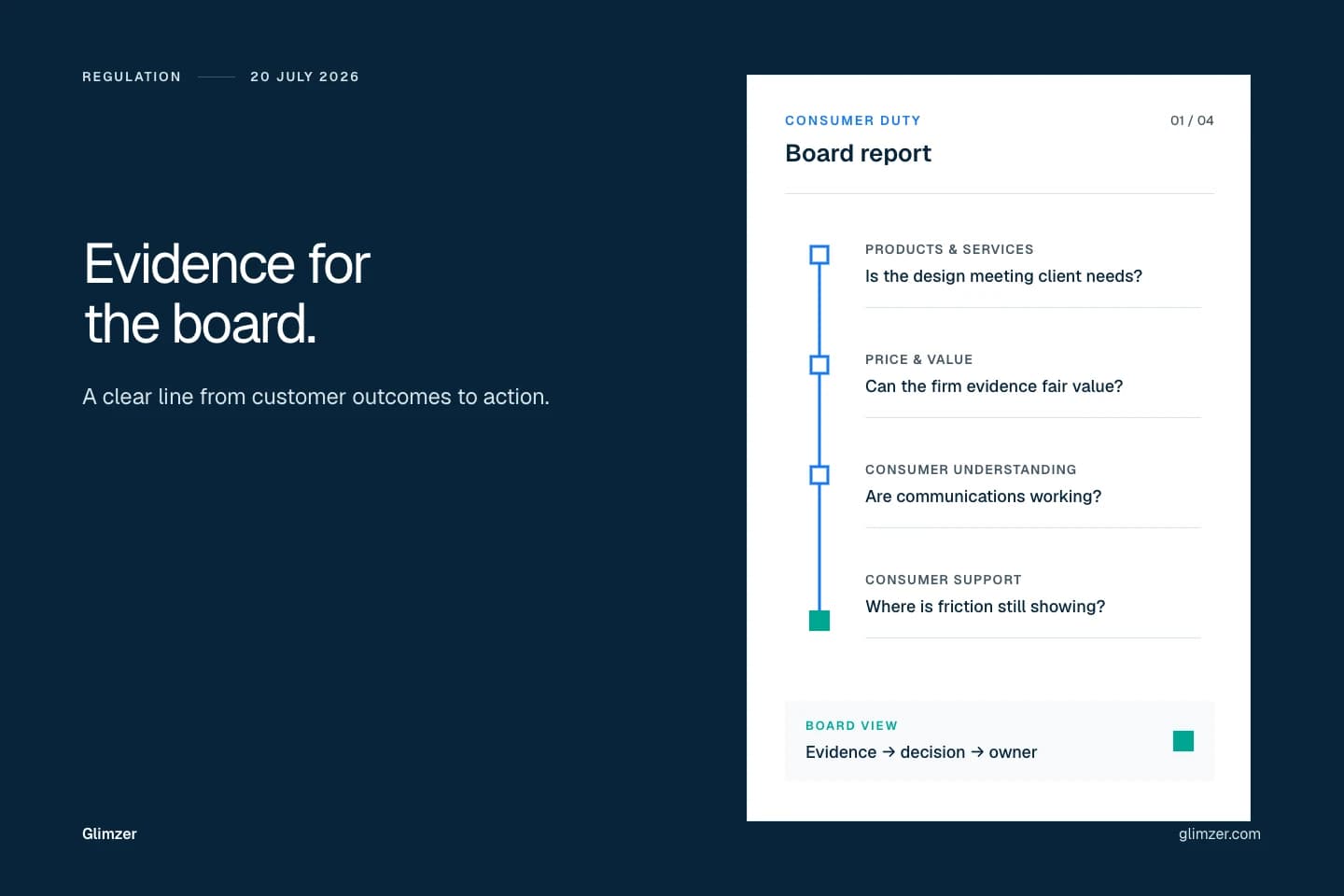
Most advice firms are confident they act in their clients' interests. Proving it in a board report, with evidence a board can challenge, is a different job.
Three years ago this month, the Consumer Duty came into force. The anniversary matters for a practical reason: board reports are annual, and the FCA has now reviewed how firms handled their first ones. It published examples of good practice and areas for improvement, and in February 2026 it added extra insight for smaller firms.
If your Consumer Duty board report is landing about now, that review is the closest thing you'll get to marking guidance.
What the FCA reviewed
The regulator looked at firms' first annual reports and grouped its findings into four areas: report governance, monitoring and outcomes, actions taken to comply with the Duty, and future business strategy.
It was careful to say the examples aren't prescriptive. There's no mandated template, and the FCA isn't asking every firm to produce the same document. The question underneath all four areas is simpler: can your board see what's happening to customers, challenge it, and show that it acted?
What good looked like
Two things stood out in the stronger reports.
They started from customer outcomes rather than activity. Not "we sent 400 annual review letters" but "here's what clients actually experienced this year, and here's where it wasn't good enough."
And they let the data speak, even when it was uncomfortable. A report that only contains good news isn't evidence of oversight, it's evidence of filtering.
Worth noting: the FCA found good practice in firms of all sizes, including teams of fewer than ten people. Size wasn't the differentiator. Evidence was.
Where reports fell short
The weaker reports shared a pattern. Data quality too thin to justify the conclusions being drawn. MI handed to the board with no explanation of what it showed or why it mattered.
A pack of charts is not assurance. If the board can't interrogate the numbers, it can't evidence oversight, and the report becomes a formality rather than a tool.
What this means for the firms we build for
In our experience, weak evidence is rarely a diligence problem. It's a systems problem.
The information usually exists: first enquiries, advice given, reviews completed, complaints, vulnerability flags. But it sits scattered across a CRM, some spreadsheets and a lot of inboxes. Assembling it into something a board can actually challenge burns days of someone's year, which is exactly why it so often arrives thin.
That gap is a big part of why we built Glimzer, a CRM and practice management platform for UK financial advice firms that keeps first enquiries, pipeline, new business and ongoing client servicing in one place. When the underlying records live together, the outcomes evidence your board needs becomes a report, not a project.
To be clear about the boundary: no software writes your board report for you, and none should claim to. The judgement stays with you and your board. Good systems just mean the data behind that judgement is already in one place, and already explained.
What's next
The Duty itself is still moving. On 29 June the FCA opened CP26/23, a consultation on the scope and proportionality of the Consumer Duty. Whatever comes out of it, the direction of the last three years hasn't changed: boards are expected to know what their customers experience, and to show their workings.
If you run an advice firm and you've ever wondered whether there's a better way to manage your pipeline and your ongoing client work, we're always happy to show you around. You can see Glimzer for yourself at glimzer.com.
Frequently asked questions
What is a Consumer Duty board report?
It's the annual report a firm's board or governing body reviews and approves, assessing whether the firm is delivering good outcomes for retail customers under the FCA's Consumer Duty. The first reports were due by 31 July 2024.
Is there a fixed deadline every year?
The requirement is annual rather than tied to one universal date. Because the first report was due 31 July 2024, many firms' cycles now land at the end of July. Check your own reporting cycle.
What does the FCA consider good practice?
Reports that start from customer outcomes, use data strong enough to support their conclusions, explain the MI presented to the board, and record where the board challenged the business.
Does the good practice guidance apply to small firms?
Yes. The FCA found good practice in firms of all sizes, including those with fewer than 10 employees, and its February 2026 update added specific insight for smaller firms.
Get regulatory updates, adviser technology and practical ideas for your firm in your inbox. Sign up for The Frontier Brief.
More insights
View all insightsRegulation
Pensions and inheritance tax: what changes in April 2027, and where firms can start
From April 2027 most unused pension funds count towards the estate for inheritance tax. What's final and where UK advice firms can start.
Insight
The Consumer Duty board report 2026 deadline is weeks away. What to have ready.
The Consumer Duty board report 2026 deadline is 31 July. What the FCA now expects, and why year-round data capture beats the July scramble.
Regulation
The FCA's new COCON rule on non-financial misconduct: what it means for financial advice firms
The FCA's new COCON rule covers serious work-related misconduct. What UK financial advice firms should review now.
See Glimzer for yourself.
Glimzer Workspace brings pipeline, clients, fees and introducers into one place for UK financial advice firms, so less gets missed and less time goes on admin.
This article is general information for people working in UK financial advice, not financial, legal or regulatory advice. Details were accurate to the best of our knowledge on the date published or last updated; rules, prices and third-party products change, so check current sources before acting. If you spot an error, email contact@glimzer.com and we'll correct it.