Regulation
What the FCA's 2026 wealth survey says about the way firms work
By Tom Matthieson · 24 August 2026
The FCA's Wealth management survey report - 2026 is not a new set of rules for financial advisers. It focuses on discretionary portfolio management and draws mainly on data collected from around 400 wealth management firms.
Even with that distinction, the report gives advice firm owners and operations teams something useful: a detailed view of what can become harder to control as firms grow, add technology and rely on more outside providers.
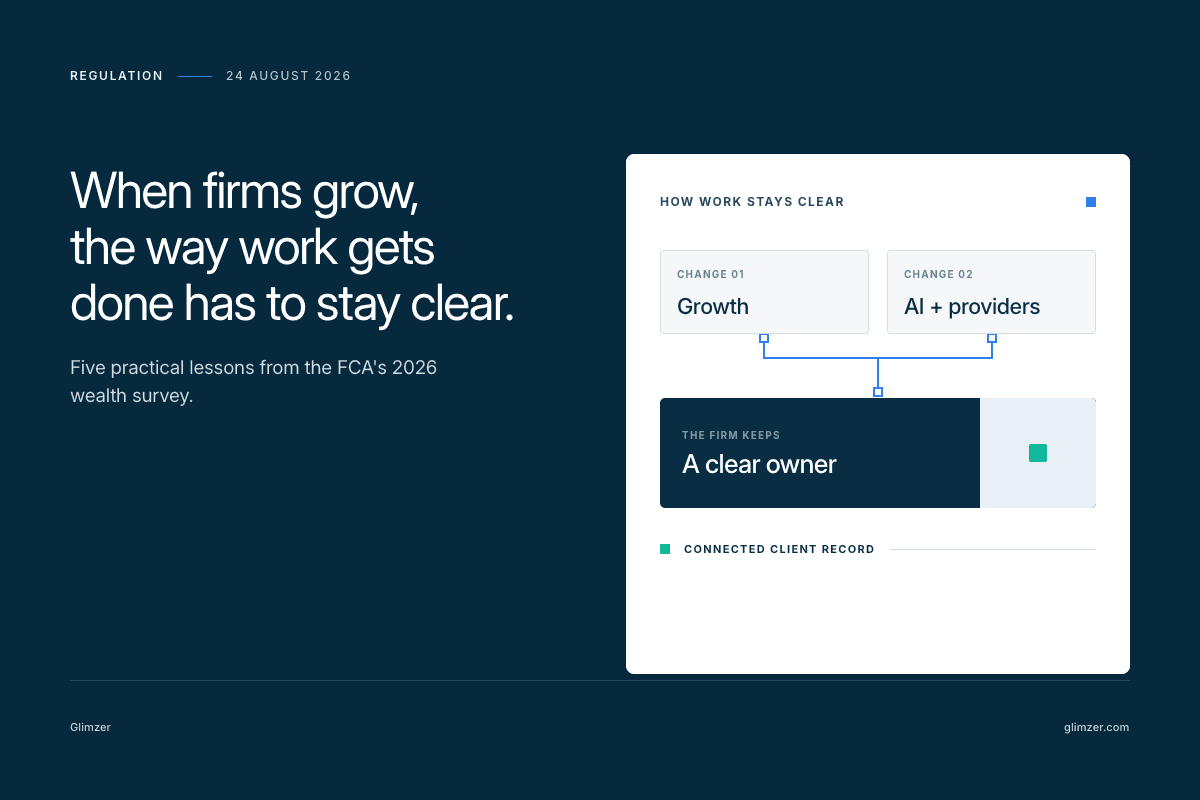
The recurring message is practical. Governance and oversight need to keep pace with changes in the way work gets done. That depends on clear ownership, usable client information and a reliable view of the service being delivered.
What the FCA report covers
The FCA published the report on 18 August 2026. It looks at market concentration, growth, digital services, AI, outsourcing, financial crime controls, vulnerability and fair value.
Its scope matters. The report concerns discretionary portfolio management, although the FCA says around 29% of the wealth managers surveyed also offer financial advice. Advice firms should not treat every figure as a benchmark for their own market.
There is also a timing caveat. Most figures come from the FCA's 2025 survey. Firms supplied their latest data up to 31 December 2024 and had until May 2025 to submit it. The report is new, but much of the evidence is a point-in-time snapshot rather than a live measure of current practice.
With those limits clear, five themes are particularly relevant to the way advice firms work.
Growth puts ownership and handovers under pressure
The FCA found that 41% of the surveyed wealth managers planned to acquire another firm, grow revenue or increase client numbers by more than 25% over the following two years. At the other end of the market, 18% were considering winding down or selling all or part of their client base.
The FCA's concern is not growth itself. It is whether governance, oversight and controls keep pace.
For an advice firm, the same practical tension can appear well before an acquisition or a large increase in client numbers. More clients create more reviews, tasks, documents, fee records and handovers. More employees create more points where ownership can become unclear.
The warning signs are familiar:
- work is allocated in meetings but not recorded in one place
- a case can only be understood by asking the person who last touched it
- owners need a spreadsheet exercise to see workload or service status
- new clients enter the firm faster than responsibilities are assigned
Growth exposes those gaps. It rarely creates them from nothing.
AI needs a defined place in the process
The survey found that 13% of firms were using in-house or third-party AI tools. This rose to 45% when firms considering AI use in the following 12 months were included. The FCA notes that adoption may now be higher because the underlying data is older.
The useful question for an advice firm is not simply whether to use AI. It is where a tool sits in a process and who remains responsible for the work.
Before introducing an AI tool, a firm can define:
- the specific task it is intended to support
- what client or firm data it can access
- who checks its output and what that check involves
- where the source information and final decision are recorded
- what happens if the tool is unavailable or produces a poor result
That creates a clearer boundary between administrative support and professional judgement. It also makes the tool part of a controlled process instead of an isolated experiment.
Outsourcing does not remove the need for visibility
More than 92% of the wealth managers surveyed outsourced some part of their business. Technology, trade execution, assurance and oversight were the most common areas.
The FCA recognises the benefits, including access to expertise and infrastructure. It also stresses that reliance on third parties creates dependencies and that firms remain responsible for the services they provide.
For an advice firm, oversight becomes difficult when supplier activity is separated from the client record. A provider may hold one status, the CRM another, and an internal spreadsheet a third. When something is delayed, the team first has to establish which version is current.
A workable process should show:
- which provider is involved and what is expected from it
- who inside the firm owns the next action
- when the item was last checked
- what the team should do if the service fails or information is missing
The aim is not to duplicate a provider's system. It is to keep enough context inside the firm to manage the client relationship properly.
Client information must be usable, not merely stored
The FCA found gaps in some firms' financial crime records, including information about expected transaction frequency, expected investment amounts and source of wealth. It also found progress in identifying clients with characteristics of vulnerability, while noting that practices remained inconsistent.
These findings come from wealth managers, but they illustrate a broader point for advice firms. A piece of information only helps if the right person can find it, understand what it means and act on it.
Recording a client's communication need is one step. The way the firm works should then carry that information into future contact, reviews and service tasks. Recording that a check took place is useful, but the team also needs to know when it should be revisited and who owns it.
This is where disconnected notes and documents become a practical risk. The information may exist somewhere, yet fail to influence the next action.
Fee visibility supports better service decisions
The FCA report also discusses fair value and pricing clarity. It cites Financial Lives 2024 data showing that 17% of adults with more than £100,000 in investible assets who used a named wealth management firm were concerned that fees were high, hidden or complex.
That finding does not describe every advised client, but it shows why fee information and service records should be considered together.
If fees sit in one system and completed service activity in another, it becomes harder for a firm to review whether the intended service is being delivered consistently. Owners should be able to examine fees, reviews and client activity without first rebuilding the picture manually.
Questions to ask about the way your firm works
The FCA report is not a checklist for advice firms, but it prompts useful questions:
- Can every open piece of client work be linked to an owner and a next action?
- Can a colleague understand a case without searching across inboxes and spreadsheets?
- Are client needs and service adjustments visible when future work is carried out?
- Can the firm see which outside providers are involved and what is outstanding?
- Does every AI-supported task have a defined purpose, review step and accountable person?
- Can owners compare the service promised, the work completed and the fees recorded?
- Would the process still work if a key employee or supplier were unavailable?
These questions are less about producing more administration and more about making existing work visible enough to manage.
Bringing the work into one view
Glimzer brings pipeline, client servicing, workflows, fee reconciliation, documents, introducer tracking and reporting into one connected workspace for UK financial advice firms.
Software cannot replace governance or professional judgement. It can give owners and teams a clearer record of who is doing what, what has happened and what needs attention next.
That is the main lesson advice firms can take from the FCA's wealth survey. As the firm changes, the way it works needs to remain clear to the people responsible for clients and for the business.
Sources
Get regulatory updates, adviser technology and practical ideas for your firm in your inbox. Sign up for The Frontier Brief.
More insights
View all insightsRegulation
The FCA's new COCON rule on non-financial misconduct: what it means for financial advice firms
The FCA's new COCON rule covers serious work-related misconduct. What UK financial advice firms should review now.
Regulation
What the FCA's wealth management survey asks about your smallest clients
The FCA's 2026 wealth management survey says some firms haven't considered how fixed fees affect clients with smaller portfolios. What can advice firms learn?
Regulation
The FCA's outcomes monitoring review is good news for small advice firms
The FCA's July 2026 outcomes monitoring review says small advice firms don't need complex systems. What it asks for instead, in plain English.
See Glimzer for yourself.
Glimzer Workspace brings pipeline, clients, fees and introducers into one place for UK financial advice firms, so less gets missed and less time goes on admin.
This article is general information for people working in UK financial advice, not financial, legal or regulatory advice. Details were accurate to the best of our knowledge on the date published or last updated; rules, prices and third-party products change, so check current sources before acting. If you spot an error, email contact@glimzer.com and we'll correct it.