Regulation
What the FCA's wealth management survey asks about your smallest clients
By Tom Matthieson · 20 August 2026
Fee models get designed around the client in the middle of the book. The clients at the bottom of it tend to get whatever the formula happens to produce.
On 18 August the FCA published its 2026 wealth management survey. It runs on data from around 400 firms, covering more than 5.5 million retail clients and almost £1tn of assets, and it's about discretionary portfolio management rather than advice. One observation in it is worth an advice firm's time anyway.
The regulator found fair value practice uneven. Some firms make detailed assessments. Others, in its words, "may not have fully considered how pricing, including fixed fees, can affect clients with smaller portfolios".
That's a survey of wealth managers. The FCA hasn't asked advice firms to do anything off the back of it, and this post isn't suggesting otherwise. The question travels regardless, because the arithmetic underneath it does.
What the survey covers
The report is built on survey responses from around 400 firms, supported by regulatory returns and other FCA and public data. The stated purpose is to help firms understand the market, see how their own approach compares, and raise standards.
Two findings took most of the coverage. The ten largest firms by client numbers now serve 89% of discretionary clients, up from 70% in 2022. And 41% of the firms surveyed plan to acquire another firm, grow revenue, or increase their client base by more than a quarter over the next two years.
The FCA's read on that is even-handed. Consolidation can support efficiency and growth by letting firms pool resources, expertise and technology. Growth that isn't managed well can lead to poor client service, weaknesses in business continuity, and in some cases disorderly failure.
Lucy Castledine, the FCA's director of consumer investments, put the whole thing as an opportunity rather than a telling-off: firms can "raise standards further, with clearer fees, fair value and strong safeguards against financial crime", building on what she called a strong foundation. Some of the trade coverage ran it as a warning. Reading the actual wording, it isn't one.
Why the small-portfolio point travels
A percentage charge moves with the client. A fixed fee doesn't.
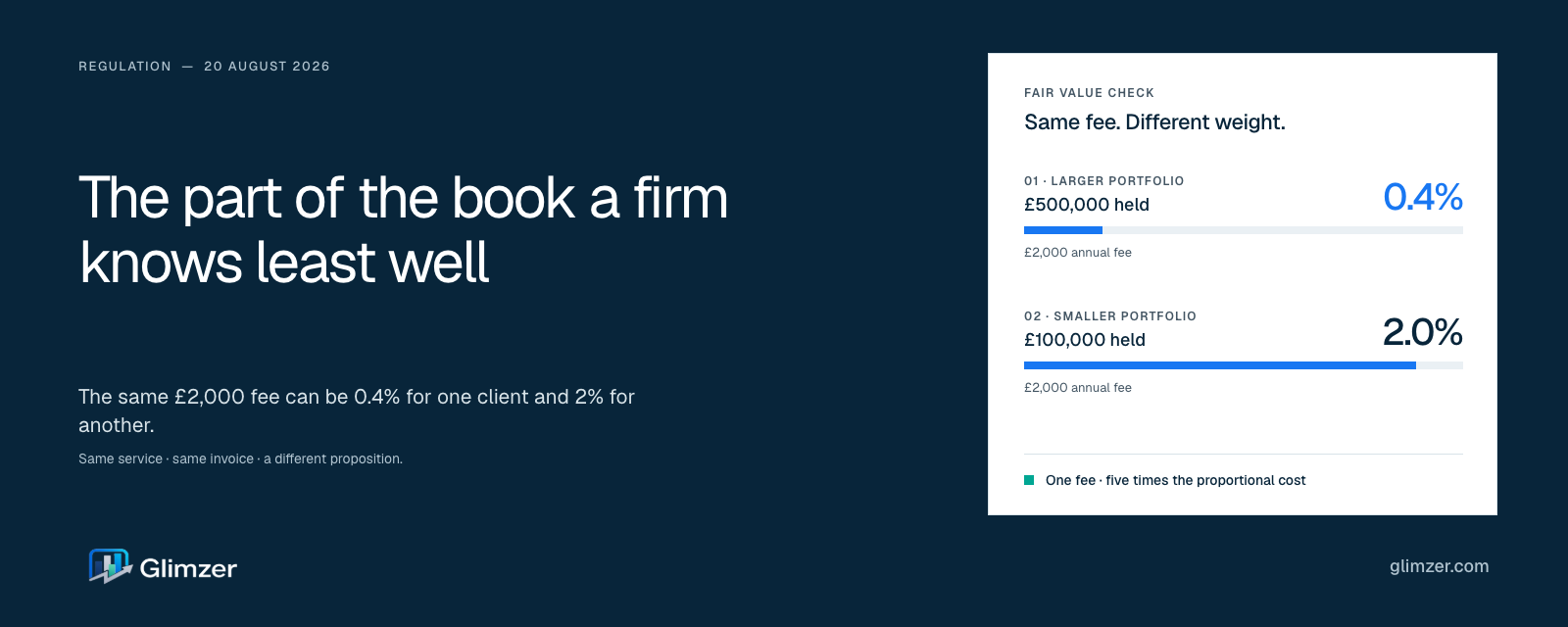
Two thousand pounds a year is 0.4% on a £500,000 portfolio and 2% on a £100,000 one. Same service, same invoice, a very different proposition at each end. No firm sets out to design that. It arrives: through a minimum fee that made sense when it was set, through a book bought from a retiring adviser, through a client who took a large tax-free lump sum and now holds a third of what they held before.
The awkward part is that the small end of the book is usually the part a firm knows least well. It's where inherited clients sit, and clients an adviser looked after for years before moving on, and the ones who quietly stopped responding to review invitations. They're rarely anybody's priority, right up until someone asks about them.
What it means for the firms we build for
The question isn't difficult in principle. For each client: what do they pay in pounds, what is that as a percentage of what they hold, and what did they actually receive for it this year?
In practice it's slow, because those three things live in three different places. The fee sits in the back-office system or on the platform. The service they were promised sits in an agreement nobody has opened since it was signed. What actually happened sits across a diary, an inbox and somebody's memory. Answering for one client is a phone call. Answering across the whole book is a project, and projects get postponed.
Glimzer is a CRM and practice management platform for UK financial advice firms. It holds the fee, the agreed service and the record of what was delivered against the same client, so a question about the bottom fifty clients in your book is a filter rather than a fortnight. That doesn't make a firm compliant, and no software should claim it does. It does mean you get to see your own pricing before anybody else asks about it.
What's next
For advice firms the more consequential document is still CP26/10, the FCA's proposal to replace the prescriptive annual suitability review with a periodic one set by client need, alongside clearer rules on charging for ongoing services. The policy statement is expected later this year.
If firms get to choose their own review frequency, they'll need to be able to show why each client's cycle is the right one. That's the same underlying capability as answering the fair value question: knowing, per client, what was promised, what it costs and what was delivered.
If you run an advice firm and you've ever wondered how long it would take to see your fees and your servicing side by side across your whole book, we're always happy to show you around. You can see Glimzer for yourself at glimzer.com.
More insights
View all insightsRegulation
What the FCA's 2026 wealth survey says about the way firms work
Practical lessons for advice firms from the FCA's 2026 wealth survey, covering growth, AI, outsourcing, client records and fee visibility.
Operations
The hidden cost of admin in financial advice firms
Most advice firms know what their software costs. Far fewer measure the time lost to rekeying, cross-checking and rebuilding client records.
Regulation
The FCA's new COCON rule on non-financial misconduct: what it means for financial advice firms
The FCA's new COCON rule covers serious work-related misconduct. What UK financial advice firms should review now.
See Glimzer for yourself.
Glimzer Workspace brings pipeline, clients, fees and introducers into one place for UK financial advice firms, so less gets missed and less time goes on admin.
This article is general information for people working in UK financial advice, not financial, legal or regulatory advice. Details were accurate to the best of our knowledge on the date published or last updated; rules, prices and third-party products change, so check current sources before acting. If you spot an error, email contact@glimzer.com and we'll correct it.